A useful starting point
For many established Neocaridina davidi lines, pH 6.5–8.0, GH 6–12 dGH and KH 2–8 dKH are practical reference ranges. They are not instructions to move an acclimated colony abruptly. Compare them with your breeder's water and your own repeated measurements. Aim for undetectable ammonia and nitrite.
GH describes water hardness associated mainly with calcium and magnesium. KH indicates carbonate buffering; it is not interchangeable with GH. A TDS reading estimates dissolved material but does not identify which minerals are present. Record these as different measurements, with their units.
What moulting looks like
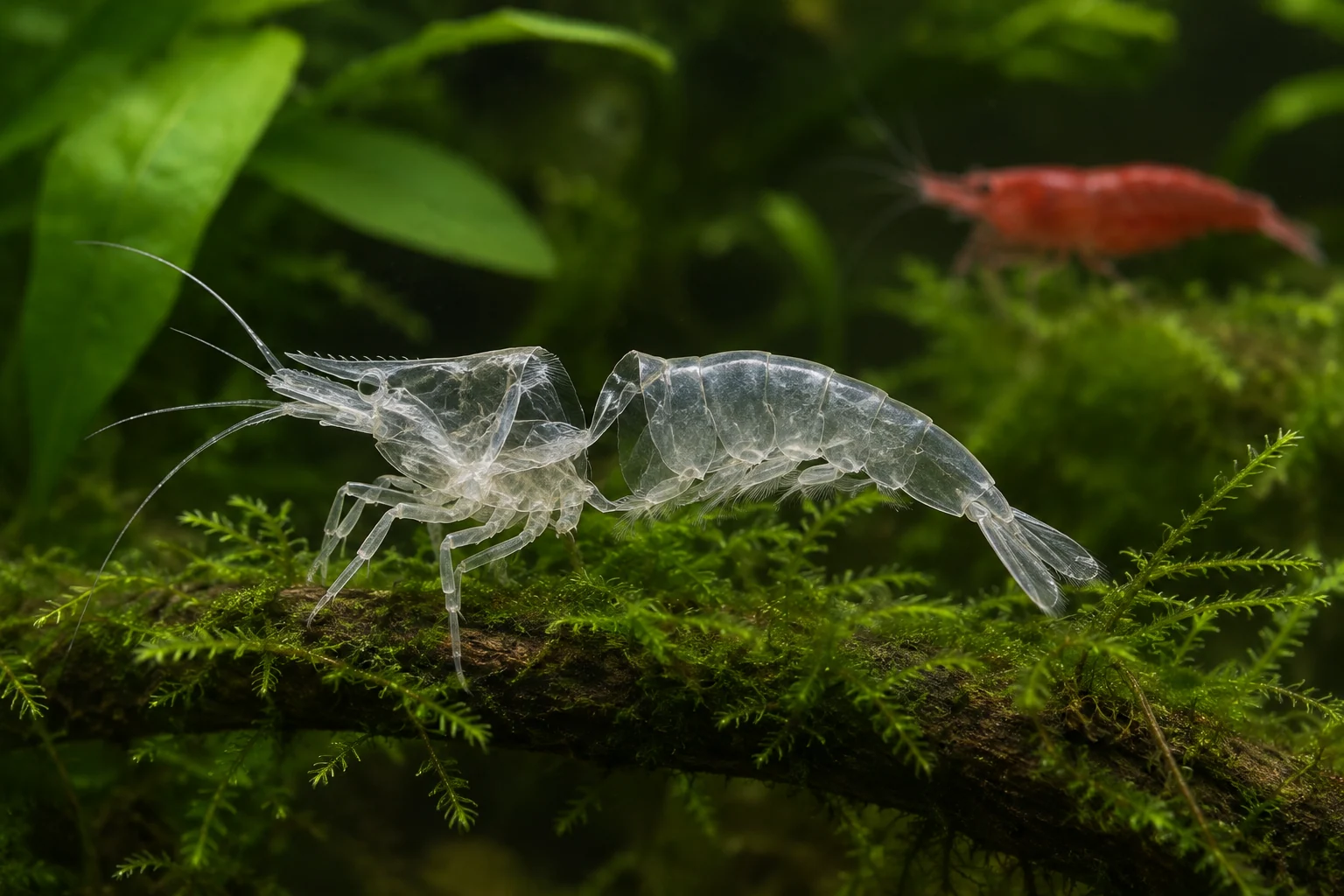
Shrimp grow by shedding their exoskeleton. A transparent, empty shell can be a normal moult, and newly moulted animals may stay under cover while their new exterior hardens. Do not disturb hiding shrimp simply to check their colour.
Moulting also accompanies development: researchers studying Neocaridina documented changes in the juvenile tail across the first moult. An unsuccessful moult is therefore more than a cosmetic issue. A visible gap or pale band alone is not a complete diagnosis; examine the animal's behaviour and the tank's recent history.
Measure before adjusting
If problems repeat, note the last water change, temperature, GH, KH, food and any new product. Test replacement water as well as aquarium water. Do not respond by adding several mineral supplements at once: the resulting change becomes difficult to measure or reverse.
Prepare replacement water separately, condition tap water appropriately and match temperature. If remineralisation is necessary, follow the selected product's instructions and verify the result before use. Keep a dated log so a trend becomes visible before the next loss.
Sources & further reading
- The Shrimp Farm: Neocaridina husbandry reference ranges ↗
- OATA: Freshwater shrimp maintenance and water testing ↗
- Adachi et al., 2025: Post-embryonic tail development through molting ↗
- Aquarium Co-Op: Recognising shrimp moults ↗
Our own explanations, informed by the references above. Husbandry needs vary with the species, line and aquarium.