
Meet Neocaridina
Neocaridina davidi is the freshwater dwarf shrimp behind many familiar cherry, blue, yellow and orange aquarium lines. These are colour forms, rather than a collection of unrelated species. This section introduces their husbandry; the colours mentioned are educational examples, not a list of Mindoro's current stock.
Do not apply one shrimp recipe to every animal. Bee-type Caridina, including Caridina logemanni, are a different group commonly maintained in softer water. Caridina itself is a large genus with diverse requirements. Identify the shrimp before buying substrate, minerals or equipment.
Design for the animals you can barely see
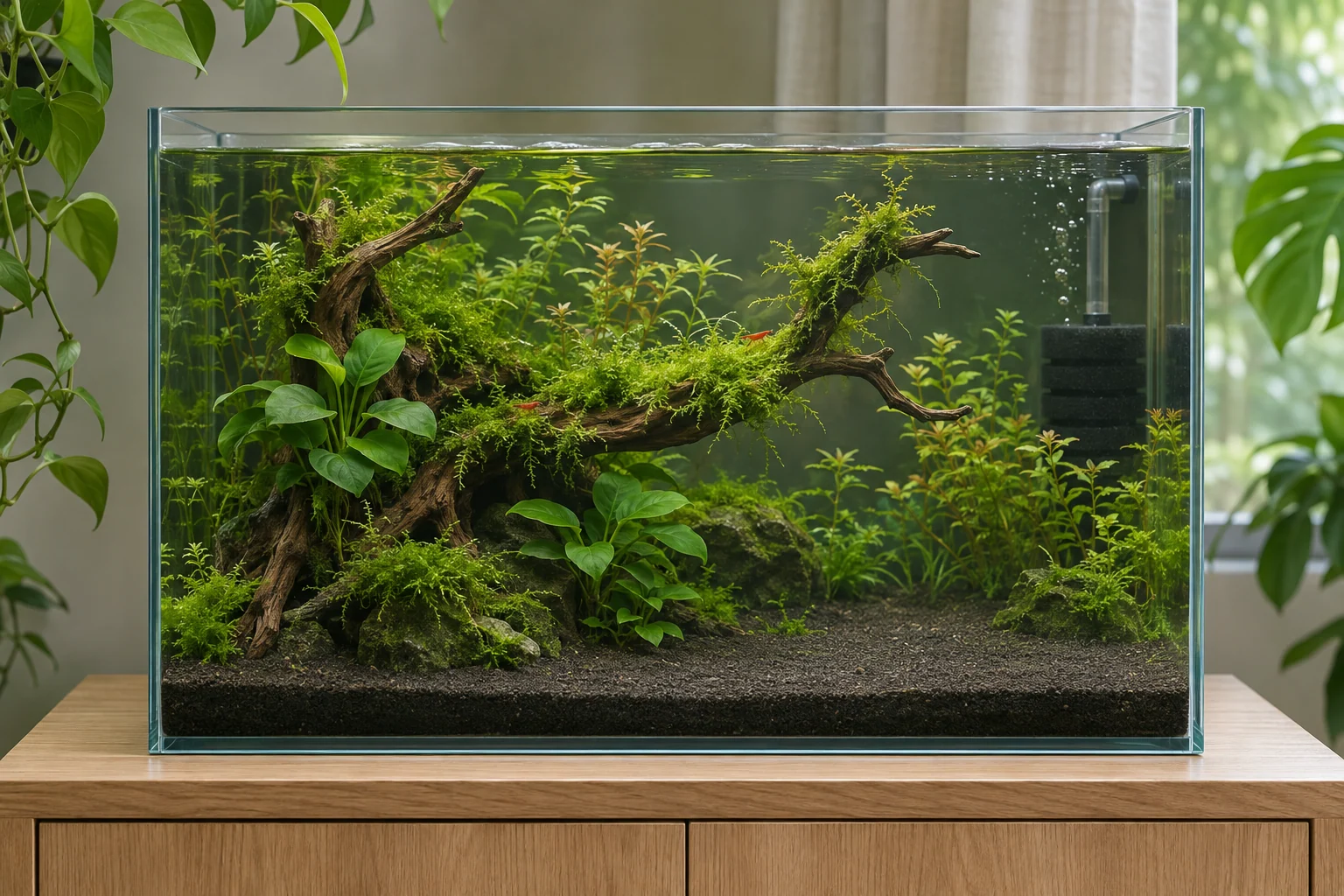
For a first breeding colony, a tank around 40 litres gives useful room for plants, observation and maintenance. A sponge filter provides gentle filtration; an intake sponge protects tiny offspring when another filter type is used. Moss, wood and planted cover create grazing surfaces and sheltered spaces.
A newly filled aquarium can look finished long before it is ready for livestock. Establish the biological filter, verify that ammonia and nitrite are undetectable, and allow grazing surfaces to develop. Clear water alone does not demonstrate a functioning nitrogen cycle.
Plan a colony, not just a display
Before ordering, decide whether this is a shrimp-only breeding aquarium or a community display. Reserve accessible space around the filter and keep a clear viewing area for spotting feeding, moulting and young shrimp. Choose equipment you can inspect easily rather than hiding every practical component.
Write down the aquarium volume, water source and test results. Ask for the breeder's current water conditions and available line before making adjustments. A simple, repeatable routine is more useful than a shelf of additives bought without knowing what the water needs.
Sources & further reading
- Aquarium Co-Op: Cherry shrimp care and aquarium setup ↗
- Dennerle: Beginner guide and shrimp groups ↗
- OATA: Freshwater shrimp and snails care ↗
Our own explanations, informed by the references above. Husbandry needs vary with the species, line and aquarium.