Different tests answer different questions
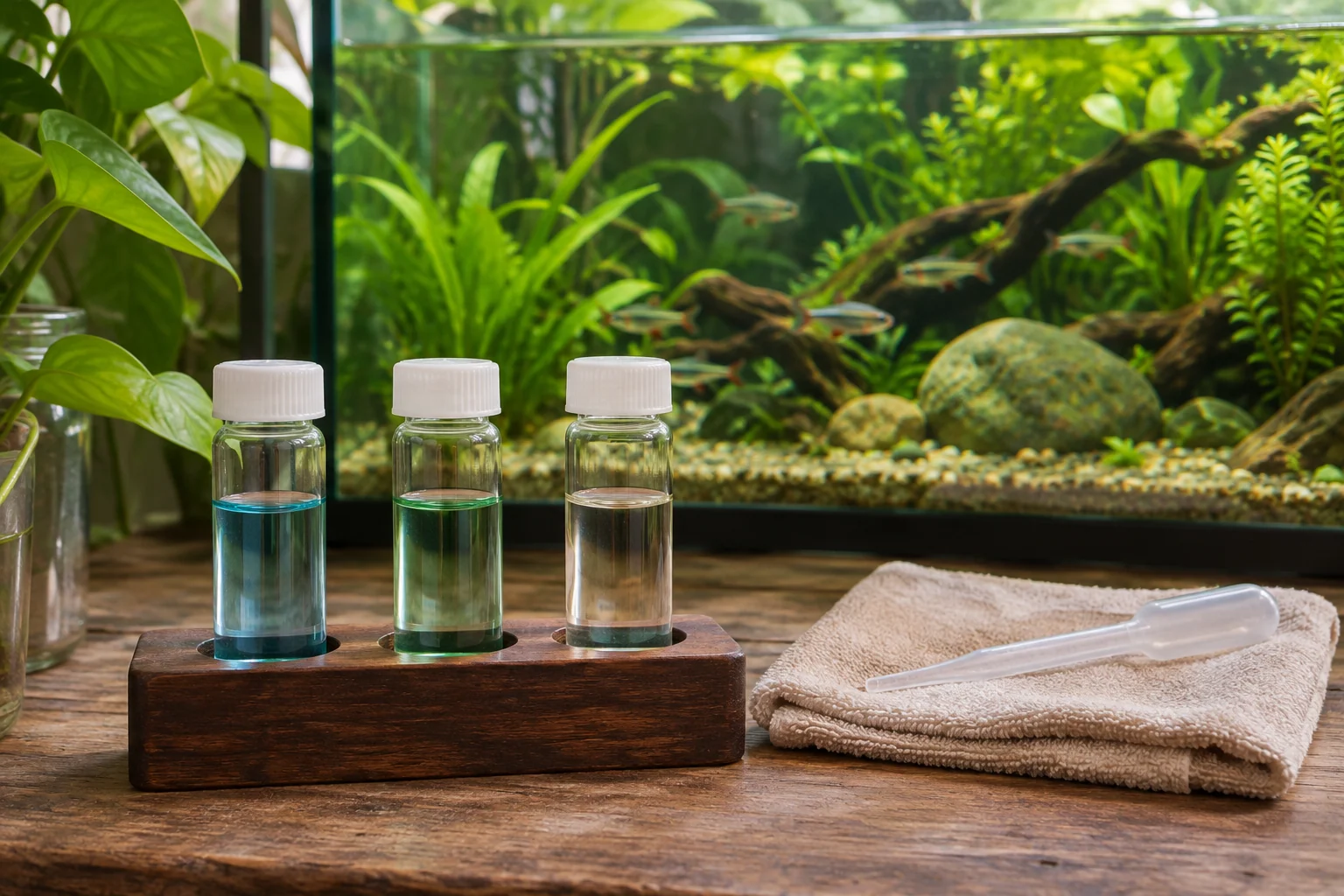
pH describes how acidic or alkaline water is. General hardness, usually abbreviated GH in aquarium keeping, mainly reflects calcium and magnesium. Carbonate hardness, commonly labelled KH on hobby tests, is used as a practical indicator of alkalinity or buffering capacity. Hardness and buffering are related in many water supplies, but they are not the same measurement.
A TDS meter estimates dissolved substances from electrical conductivity. It is useful for tracking change, but the same reading can represent very different mixtures. TDS cannot replace tests for ammonia, nitrite, GH or KH.
- pH
- How acidic or alkaline the water is.
- GH
- General hardness, mainly from dissolved calcium and magnesium.
- KH
- An aquarium test used to estimate carbonate buffering against changes in pH.
To assess stability, compare readings taken at similar times over several days.
Match water to the inhabitants
Choose a species-compatible range, then maintain it consistently. Do not assume guppies, mollies, neon tetras and shrimp all have identical requirements because they are sold as tropical freshwater animals. Ask about the conditions in which the actual stock has been raised, especially when the destination water differs substantially.
Test the source water as well as the aquarium. A stable tank reading is more informative when you know what every water change introduces. For mixed or remineralised water, prepare the recipe outside the aquarium and verify it before use.
Change deliberately
Avoid repeated additions of pH-up and pH-down products to pursue a number. First investigate the cause: source water, substrate, buffering, biological activity or a maintenance change. Make corrections gradually and with measurements.
Temperature also influences oxygen availability and animal metabolism. In a warm room, the important problem may be overheating rather than a missing heater. Record daily extremes when planning an outdoor system or a tank near a sunny window.
- Record units: degrees of hardness and mg/L are not interchangeable.
- Use species needs, not a universal tropical target.
- Keep a source-water baseline for comparison.
Sources & further reading
- Emeraldking Aquatics — Water parameters ↗
- UF/IFAS — Water Quality Notes: Alkalinity and Hardness ↗
- UF/IFAS — Dissolved Oxygen for Fish Production ↗
- U.S. Geological Survey — pH and Water ↗
Our own explanations, informed by the references above. Husbandry needs vary with the species, line and aquarium.