
Look before you feed
Take a quiet minute to watch the aquarium before food changes everyone's behaviour. Look at breathing, posture, swimming and the distribution of fish. Check that filters and air lines are working, temperature is appropriate and every expected animal can be accounted for.
At feeding time, watch who actually eats. A fish staying behind the group, repeatedly missing food or being excluded may need attention long before obvious external damage appears. Note changes rather than relying on memory across several similar tanks.
Schedule work, then adjust to evidence
Use regular water testing and maintenance as a baseline. The required water-change amount and frequency depend on stock, feed, plants, source water and filtration. A lightly stocked planted display and a heavily fed fry tank should not inherit the same routine simply because both hold the same volume.
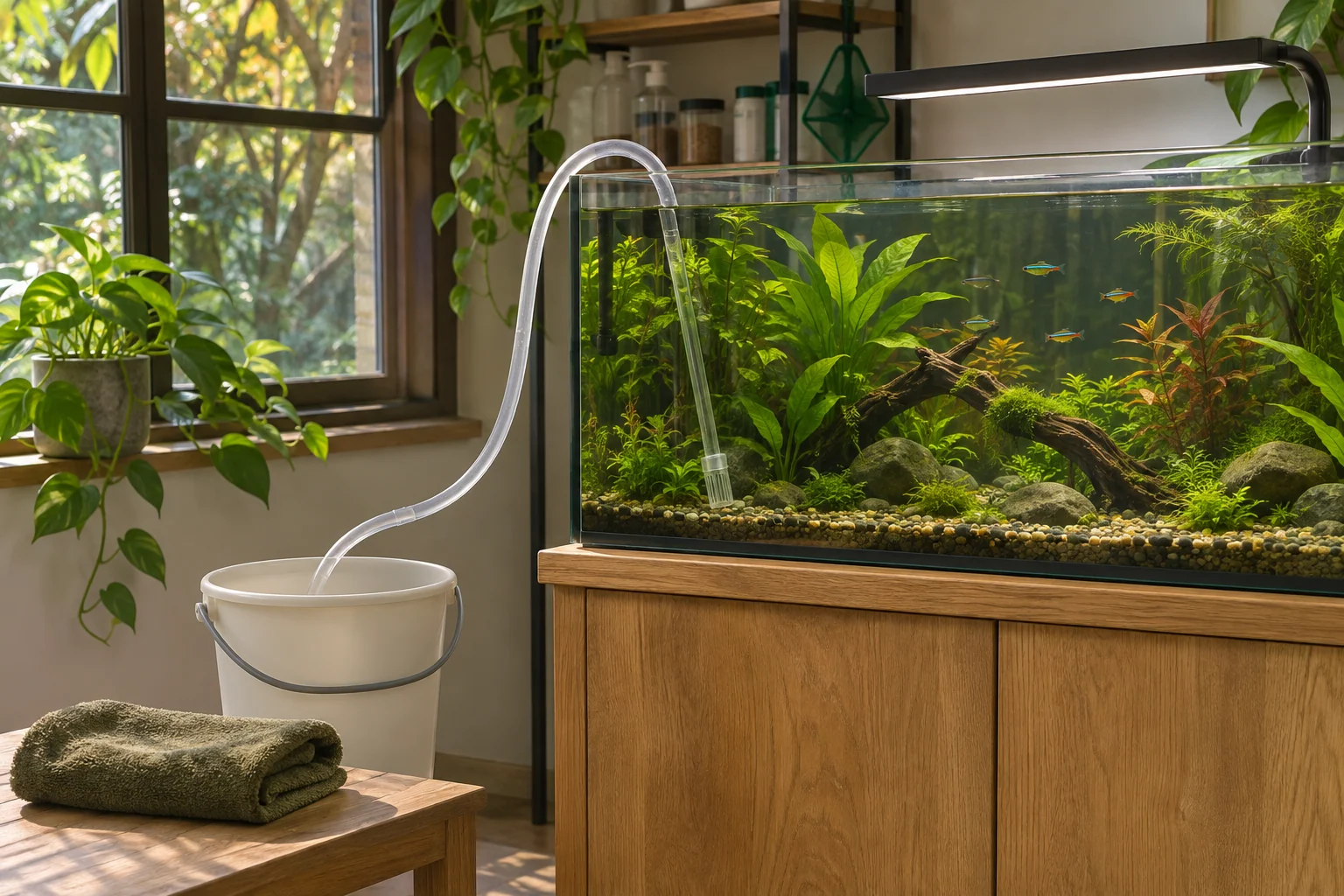
Remove accumulated waste where practical, clean viewing glass and keep flow paths open. Service filters when needed, while preserving functioning biological media. Avoid carrying out every disruptive cleaning task at once unless a specific contamination problem requires it.
- ObserveWatch the fish and check flow and temperature before feeding.
- MeasureTest the water and use the readings to guide the work.
- LogRecord the date, readings and what changed.
Make the routine easy to continue
Keep dedicated aquarium buckets and label nets or siphons used for quarantine. Prepare replacement water and check its compatibility before starting. A short tank log is more useful than an ambitious schedule nobody maintains.
Suggested log fields are date, temperature, key tests, water changed, filter work, feeding change, births and unusual observations. If a problem appears, this timeline helps distinguish a gradual trend from an event such as an outage or new arrival. After equipment work, confirm flow again rather than assuming the switch being on means water is moving.
- Observe daily.
- Use test trends to set maintenance frequency.
- Recheck equipment after every service.
- Keep quarantine equipment separate.
Sources & further reading
- Emeraldking Aquatics — Routine ↗
- UF/IFAS — Fish Health Management in Recirculating Systems ↗
- UF/IFAS — Introduction to Fish Health Management ↗
Our own explanations, informed by the references above. Husbandry needs vary with the species, line and aquarium.