
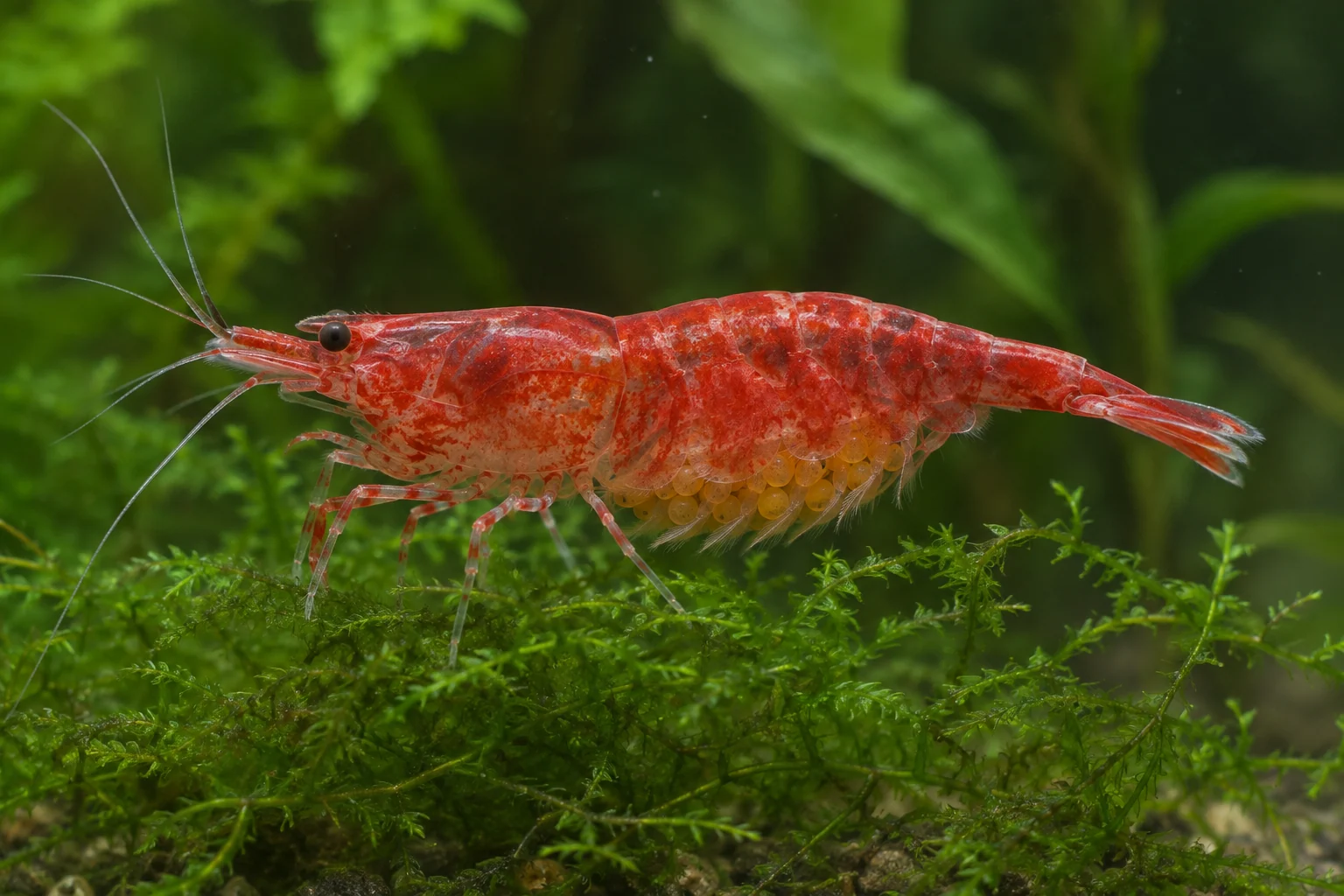
Read the life cycle
A female carrying eggs beneath her abdomen is described as berried. She tends those eggs until they hatch. Neocaridina davidi has highly abbreviated development. The tiny hatchlings continue developing in freshwater.
Do not confuse a saddle, the developing ovaries visible behind the head in some females, with an attached clutch. Use observation rather than handling to follow a female. Photographing her from the same position gives a useful record without repeatedly catching her.
- Berried femaleEggs held beneath the abdomen.
- New hatchlingsTiny young develop in freshwater.
- Growing juvenilesThe young grow through successive moults.
Count growing juveniles
A clutch is a milestone, not a guaranteed number of surviving offspring. Research following successive Neocaridina spawns found changes in egg production and maternal provisioning across broods. Consequently, one female's first clutch is not a reliable production forecast for an entire colony.
Provide sheltered grazing surfaces, protect filter intakes and make routine maintenance gentle enough to check for hidden young. Inspect the water-change bucket before discarding its contents. A shrimp-only aquarium makes it easier to distinguish husbandry problems from predation.
Do not turn up the heat to chase numbers
Temperature influences development and reproduction, but warmer is not automatically better. Controlled studies compared several temperatures and found adverse reproductive outcomes at high temperatures. Those experiments do not establish a universal optimum for every aquarium or colour line.
For a home breeding project, prioritise a stable, suitable temperature and watch the aquarium during hot afternoons. Record when females become berried and when juveniles appear. If breeding pauses, review adult sex and maturity, water quality, temperature, feeding and possible predators before making changes. Follow one adjustment long enough to understand its effect.
Sources & further reading
- Tropea and López Greco, 2015: Female growth and offspring quality over successive spawnings ↗
- Tropea et al., 2015: Temperature, growth and reproduction in red cherry shrimp ↗
- Losing Reproduction, 2018: High temperature and Neocaridina egg quality ↗
- Aquarium Co-Op: Female shrimp and breeding stages ↗
- Pantaleão et al.: Post-hatching development of Neocaridina davidi ↗
Our own explanations, informed by the references above. Husbandry needs vary with the species, line and aquarium.