
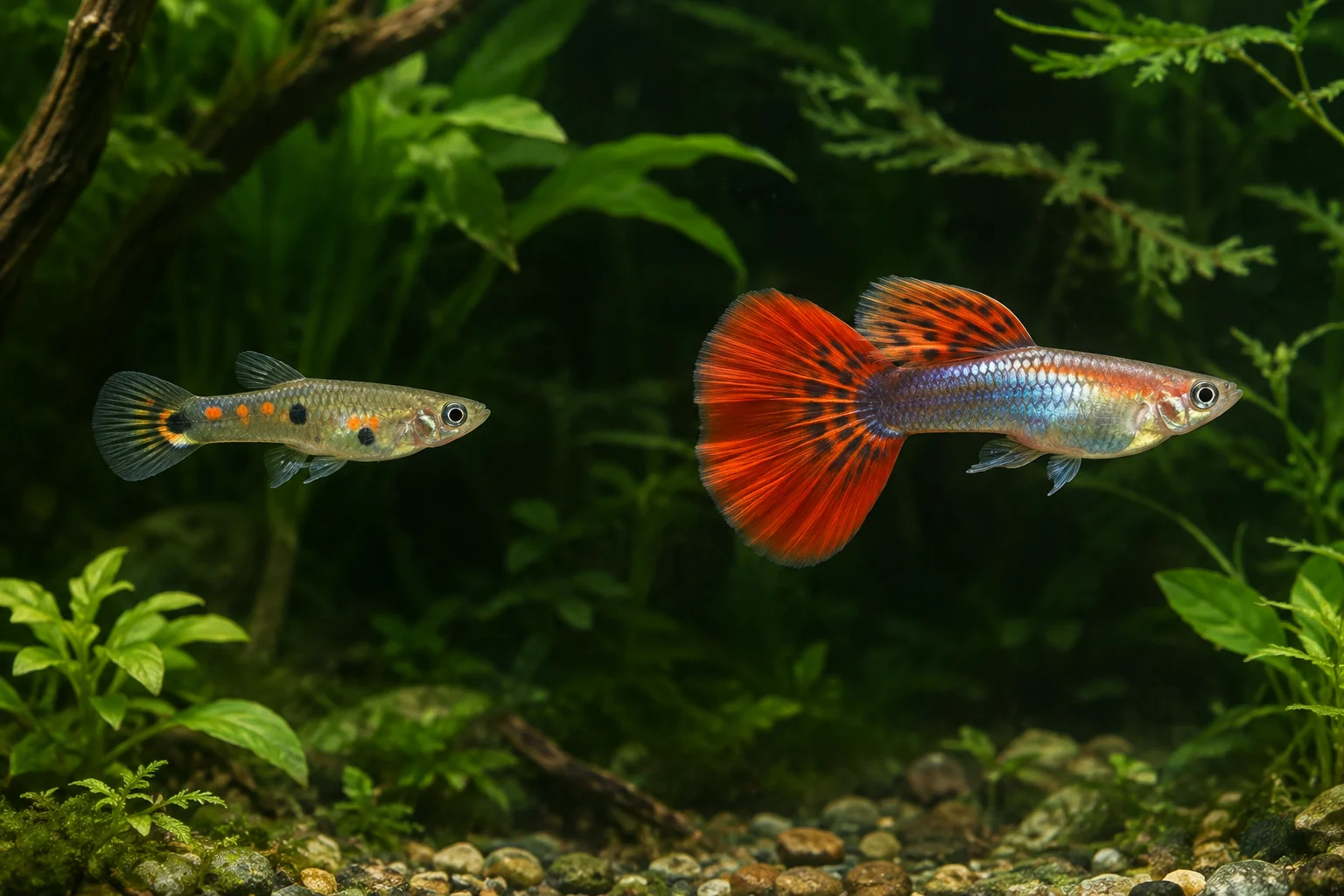
Variation did not begin in the fish room
Wild populations already contain variation. Selective breeding changes the frequency and combination of inherited features; it does not mean every spot, shimmer or fin characteristic was invented in captivity. Domestic livebearers can retain visual elements also seen in their wild relatives.
Emeraldking's observations of mollies and swordtails are a useful starting point for looking more closely. A familiar shimmer or marking, however, is not enough to prove its genetic mechanism or trace an individual fish to a particular wild population.
Use three different labels carefully
A scientific species name identifies a taxon. A strain name identifies a selectively maintained appearance or lineage. A locality describes documented geographic origin. These labels answer different questions and should not substitute for each other.
Likewise, wild-type describes an appearance or reference form; wild-caught describes collection history. A fish can resemble a wild form while being many generations captive-bred. A name containing Wild, Koi, Moscow or Glass Belly is not, by itself, proof of geographic origin, ancestry or genetic purity.
Keep curiosity without inventing certainty
Unexpected offspring can arise from hidden variation, recombination or a cross that was not fully controlled. Before calling one a new mutation, review the parents, prior matings and rearing conditions. Repeat the observation and photograph its development. A colour that appears only at maturity should not be judged from a juvenile image.
For a breeder, careful naming is part of good service: buyers should know whether they are choosing a documented line, a mixed colony or an experimental cross.
- Preserve supplier and breeder records.
- Label experimental crosses separately.
- Reserve locality claims for fish with a traceable origin.
Sources & further reading
- Emeraldking Aquatics — Wild traits in livebearer breeding forms ↗
- Kottler & Schartl — The Colorful Sex Chromosomes of Teleost Fish ↗
- Emeraldking Aquatics — Wild guppy 1 ↗
Our own explanations, informed by the references above. Husbandry needs vary with the species, line and aquarium.