
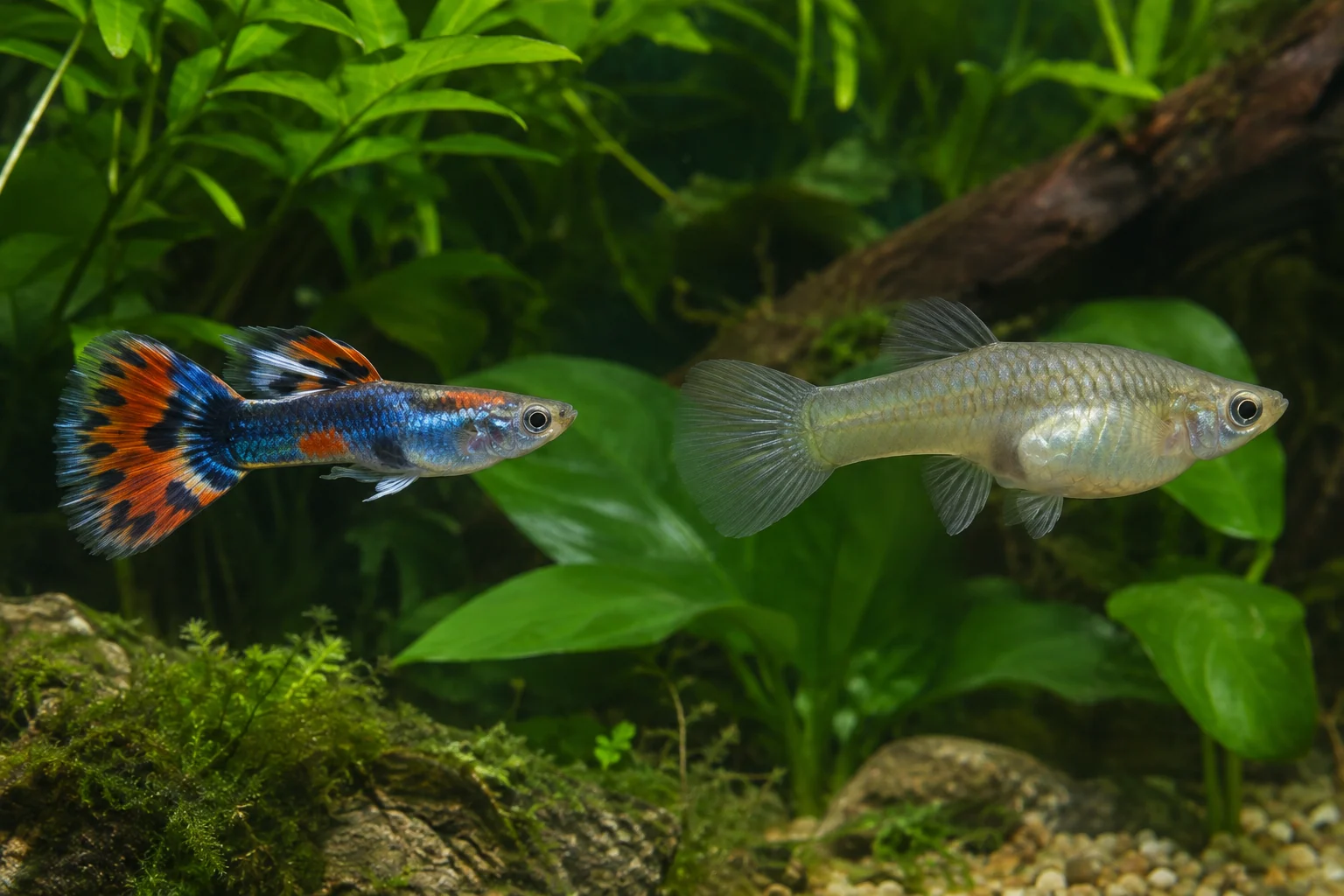
Three routes through a pedigree
Guppies generally have an XX female and XY male sex-determination system. Genetic factors may lie on autosomes or on the sex chromosomes. A strictly Y-linked factor follows the paternal line to sons; an X-linked factor follows a different route because sons receive their X chromosome from their mother.
Many male ornaments have sex-linked components, which helped make guppies a classic genetics research animal. Nevertheless, the complete colour pattern is more complicated than a single factor travelling unchanged from father to son.
- Y chromosome
- A father passes his Y chromosome to sons.
- X chromosome
- A father passes his X chromosome to daughters. Sons receive their X from their mother.
- Autosomes
- Offspring inherit one copy of each autosome from each parent.
What research adds to the breeder's notebook
Genetic mapping has linked variation in male size and colour to several genomic regions. Research also distinguishes individual ornaments from the total area of orange, black or iridescent colour. Those measurements do not necessarily have the same inheritance pattern.
A factor can be present in both sexes yet expressed mainly in males. That is sex-limited expression, not proof that it exists only on the Y chromosome. Recombination between parts of the X and Y adds another complication. Findings from one population or pedigree should not automatically become rules for every commercial strain.
Design a better comparison
Where health and space permit, compare reciprocal crosses: a male from line A with females from line B, and a male from B with females from A. Keep the families separate and rear them under comparable conditions. Differences between these directions can be informative, although they do not by themselves identify a gene.
- Track maternal and paternal lines equally carefully.
- Keep colour descriptions separate from assumed chromosome locations.
- Do not promise exact Moscow, snakeskin or glass-belly ratios without line-specific evidence.
Sources & further reading
- Tripathi et al. — Genetic linkage map and QTL analysis of male size and colour ↗
- Morris et al. — High-resolution characterization of male ornamentation and re-evaluation of sex linkage ↗
- Charlesworth et al. — Locating the Sex Determining Region of Linkage Group 12 ↗
Our own explanations, informed by the references above. Husbandry needs vary with the species, line and aquarium.