The vocabulary that makes breeding clearer
A gene is a stretch of DNA with a biological function. Different versions of a gene are called alleles. At a typical autosomal locus, a guppy inherits one allele from each parent. Two matching alleles are homozygous; two different alleles are heterozygous. These words describe a particular locus, not whether an entire fish is genetically identical to another.
Genotype describes genetic makeup. Phenotype is what can be observed: a colour patch, tail shape, growth pattern or other measurable characteristic. The two are related, but a photograph does not reveal every allele a fish carries.
- Genotype
- The alleles at a given locus, such as Aa in a single-gene model.
- Phenotype
- An observable trait, such as tail shape or the colour of a patch.
Dominant does not mean better
Under complete dominance, one copy of a dominant allele is sufficient for the corresponding phenotype; a recessive phenotype needs two recessive copies at that autosomal locus. Dominance does not mean stronger, healthier, more common or more valuable. Nor does it mean that an allele is inherited more often.
Actual guppy coloration involves pigment cells, reflective cells, their distribution and interactions among genetic factors. Sex, age and the environment also affect expression. A plain-looking female may carry useful colour factors that are expressed differently in her sons.
Apply the terms to your own fish
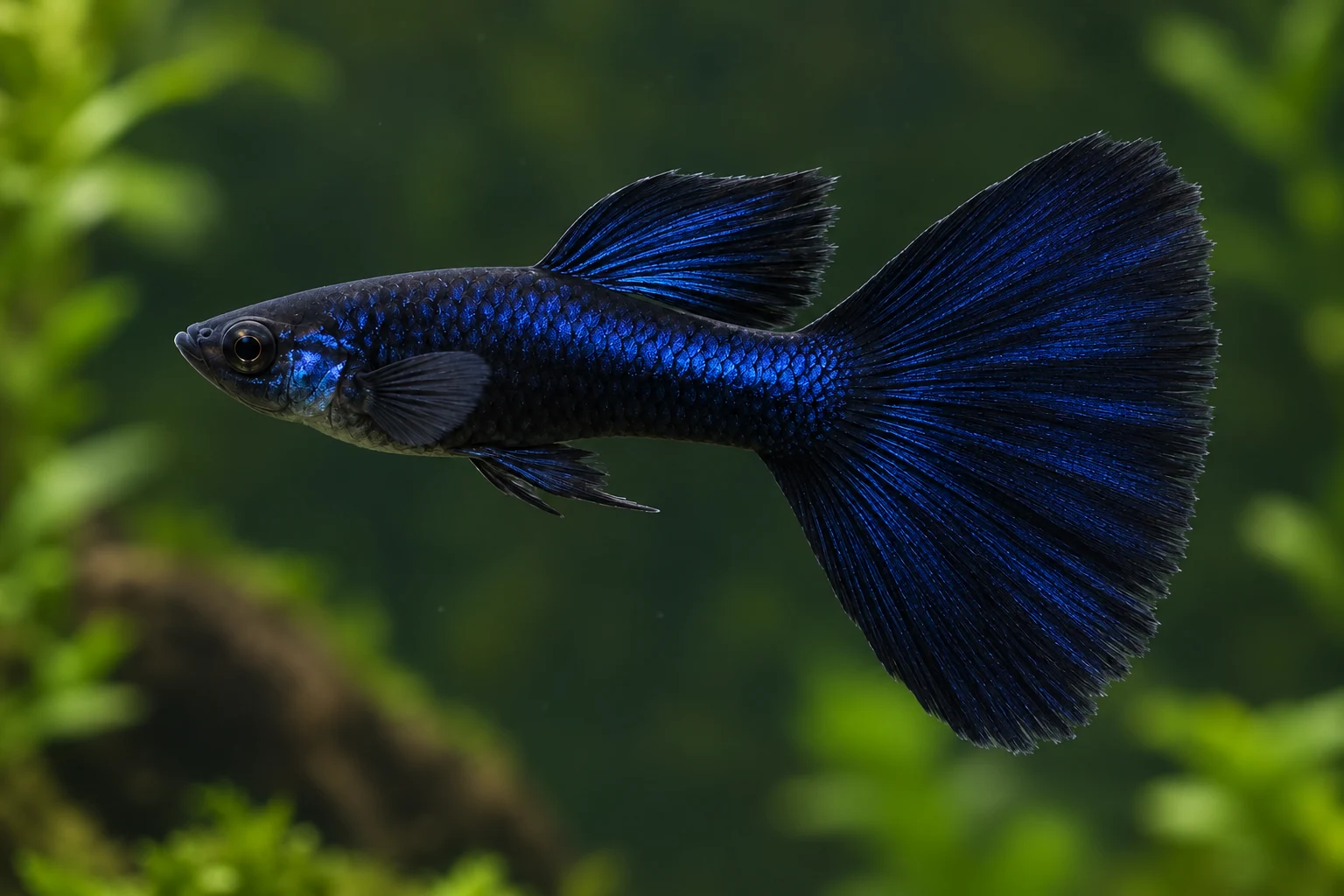
Describe what you can see separately from what you have demonstrated. A label such as Black Moscow identifies a breeding strain; it does not provide a complete genotype. Treat inheritance claims as working hypotheses until controlled crosses support them.
- Record the strain and source of both parents.
- Photograph offspring at comparable ages under the same lighting.
- Use precise descriptions such as darker body coverage instead of assuming one universal black gene.
Sources & further reading
- NHGRI — Allele ↗
- NHGRI — Dominant Traits and Alleles ↗
- Kottler & Schartl — The Colorful Sex Chromosomes of Teleost Fish ↗
- Emeraldking Aquatics — Basic guppy genetics ↗
Our own explanations, informed by the references above. Husbandry needs vary with the species, line and aquarium.