
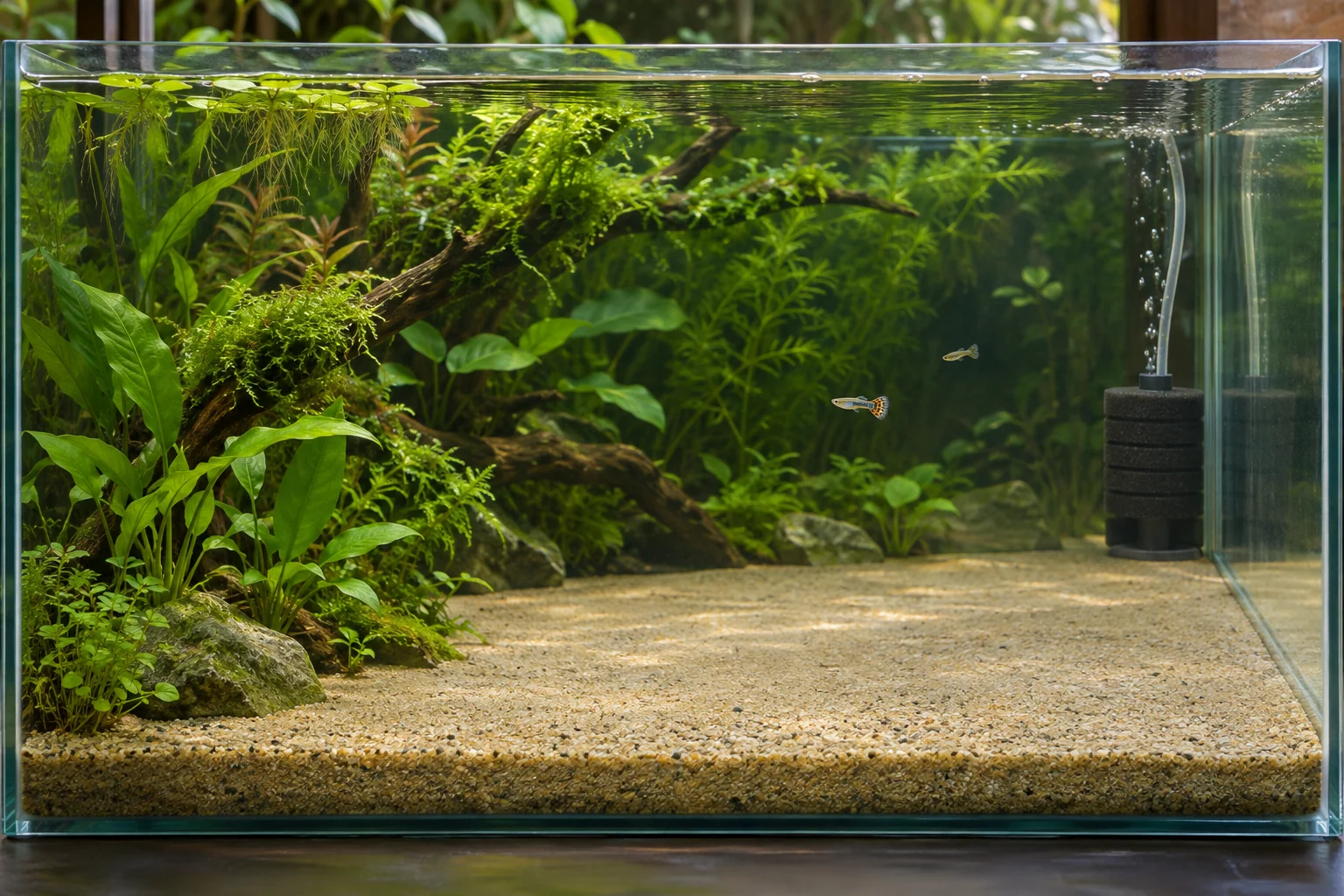
Begin with a floor plan
A good breeding or display tank balances open space with cover. Place plants and hardscape so fish can leave each other's sight, while retaining room for normal movement and observation. Think about the mature size of the plants and the adult fish, not only how the layout looks on the first day.
Tank footprint matters alongside volume. A tall decorative aquarium is not automatically equivalent to a longer tank for active fish. Equipment should remain accessible, and every intake should be appropriate for the smallest inhabitants.
- Planted cover
- Breaks sight lines and gives fish a place to retreat.
- Open swim lane
- Leaves room for movement and observation.
- Service access
- Keeps the filter, feeding area and substrate within reach.
Plants are living equipment
Plants create surfaces, refuge and visual structure. Growing vegetation can take up nutrients, but it does not make an aquarium maintenance-free. Plants respire as well as photosynthesise; in darkness they consume oxygen without producing it through photosynthesis.
Avoid allowing floating growth to completely seal the surface or leave the whole aquarium in deep shade. Inspect lower leaves, remove decaying material and keep filtration working. For shrimp or fry, fine cover is useful, but leave an area where you can check feeding and condition.
Make beauty compatible with care
Choose plants suited to the available light, temperature and water. Begin with a manageable planting plan rather than adding fertiliser or carbon dioxide to solve an unidentified problem. Check any treatment's suitability for the animals, especially invertebrates.
Our suggested layout uses denser cover at the sides or back, an observable feeding area and a route for gentle circulation. Keep clean access to the substrate and enough space to catch a fish without dismantling the entire aquarium. A tank is successful when its occupants can thrive and its keeper can maintain it consistently.
- Protect intakes for fry and shrimp.
- Retain open water and surface access.
- Trim before growth blocks inspection or flow.
Sources & further reading
- Emeraldking Aquatics — Fishtanks ↗
- Emeraldking Aquatics — Plants ↗
- UF/IFAS — Aquatic Plants and Water Management ↗
- UF/IFAS — Responsible Aquarium Fish Ownership ↗
Our own explanations, informed by the references above. Husbandry needs vary with the species, line and aquarium.